Babbel vs Duolingo: Which Language App Fits Your Goals?
Babbel vs Duolingo compared by pricing, teaching style, language selection, speaking tools, study habits, and expert-backed learning research.
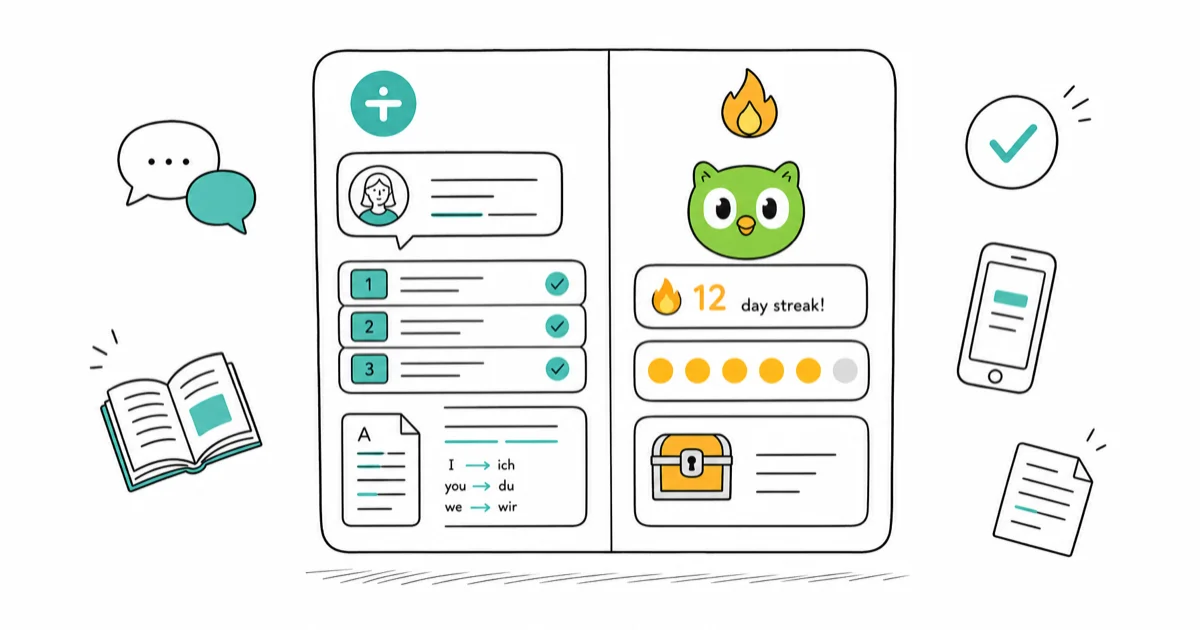
Quick AnswerBabbel is better for structured, conversation-focused learning with grammar explanations, while Duolingo excels as a free, gamified option for casual learners. Babbel requires a subscription but offers deeper content; Duolingo is free with optional premium features.
Babbel and Duolingo solve different language-learning problems. Babbel is built around structured lessons and grammar explanations, while Duolingo focuses on free access, short sessions, and habit-forming motivation. The right choice depends on whether you want structure or momentum.
- A University of South Carolina study found that 15 hours of Babbel usage equaled one college semester of language study, while Duolingo required 34 hours to reach the same benchmark
- Babbel offers 14 languages with in-depth, expert-crafted courses, while Duolingo supports over 30 languages including fictional ones like Klingon and High Valyrian
- Babbel costs $6.95 to $13.95 per month depending on subscription length, while Duolingo’s free tier covers all languages and Super Duolingo runs $6.67 to $12.99 per month
- Babbel’s speech recognition tools are generally rated more accurate than Duolingo’s, making it a better fit for learners who prioritize speaking fluency
- Both apps work best as supplements rather than standalone solutions for reaching advanced fluency
#Babbel vs Duolingo at a Glance
| Feature | Babbel | Duolingo |
|---|---|---|
| Price | $6.95-$13.95/mo | Free (Super: $6.67-$12.99/mo) |
| Languages | 14 | 30+ |
| Lesson length | 10-15 minutes | 3-5 minutes |
| Focus | Grammar + conversation | Vocabulary + gamification |
| Speech tools | Advanced recognition | Basic recognition |
| Offline mode | All plans | Premium only |
#Learning Approaches Compared
#Babbel’s Structured Method
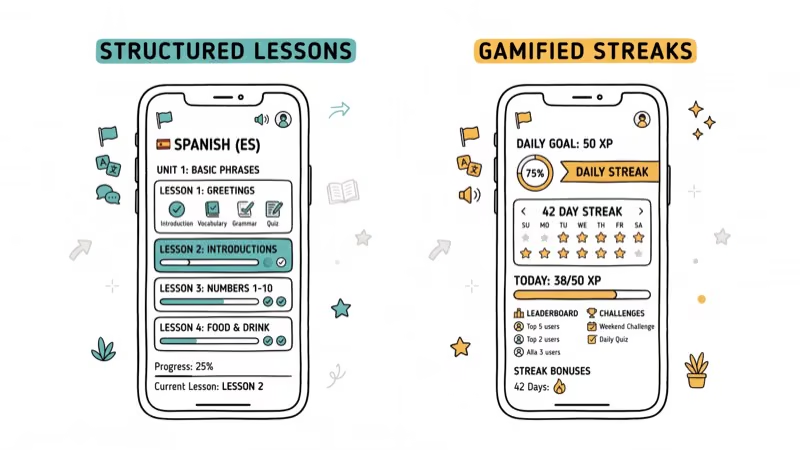
Babbel takes a traditional approach. Each lesson builds on the previous one with clear grammar explanations in English followed by practice exercises. That makes it easier to understand grammar rules upfront rather than figuring them out only through pattern matching.
Key features:
- Conversation dialogues based on real-life scenarios (ordering food, booking hotels)
- Grammar tables that explain conjugations and tenses clearly
- Spaced repetition review that surfaces words right before you forget them
- Cultural notes that explain context behind expressions
According to a study published by City University of New York and the University of South Carolina, 15 hours of Babbel usage was equivalent to one full college semester of language instruction. That’s an impressive efficiency rate.
#Duolingo’s Gamified Method
Duolingo turns language learning into a game. Lessons take 3-5 minutes, you earn XP points, and the streak counter creates real pressure to practice daily. The gamification is the main reason Duolingo works well for casual learners who need reminders and momentum.
What stands out:
- Bite-sized lessons that fit into a 5-minute break
- Leaderboards and achievements that add competitive motivation
- Adaptive difficulty that adjusts based on your mistakes
- Stories and podcasts for reading and listening practice in major languages
A University of South Carolina study found that 34 hours of Duolingo equaled one university semester. That’s roughly half the efficiency of Babbel, but the free price tag makes it a different value calculation.
#Language Selection
Babbel offers 14 languages: Spanish, French, German, Italian, Portuguese, Polish, Russian, Dutch, Turkish, Danish, Norwegian, Swedish, Indonesian, and English.
Duolingo offers over 30 languages including everything Babbel has plus Japanese, Korean, Chinese, Arabic, Hindi, Vietnamese, Greek, Irish, Hawaiian, and even Klingon and High Valyrian.
Uncommon-language learners should start with Duolingo; Babbel focuses on major European languages.
One caveat: Duolingo’s course quality varies. Its Spanish and French courses are much deeper than some smaller courses. According to Duolingo’s blog, the company publishes language-specific course updates and learning research, so course depth can vary by language.
For a comparison with another premium option, check our Babbel vs Rosetta Stone breakdown. If you’re deciding between Duolingo and Rosetta Stone instead, see our Duolingo vs Rosetta Stone guide.
#Pricing and Value
#Babbel Pricing
- 1 month: $13.95
- 3 months: $9.95/mo
- 6 months: $8.45/mo
- 12 months: $6.95/mo
All plans include full access to one language. Babbel offers a 20-day money-back guarantee.
#Duolingo Pricing
- Free tier: All languages, all lessons (with ads and limited hearts)
- Super Duolingo monthly: $12.99/mo
- Super Duolingo yearly: $79.99/yr ($6.67/mo)
Super Duolingo removes ads, adds unlimited hearts, enables offline lessons, and unlocks mastery quizzes.
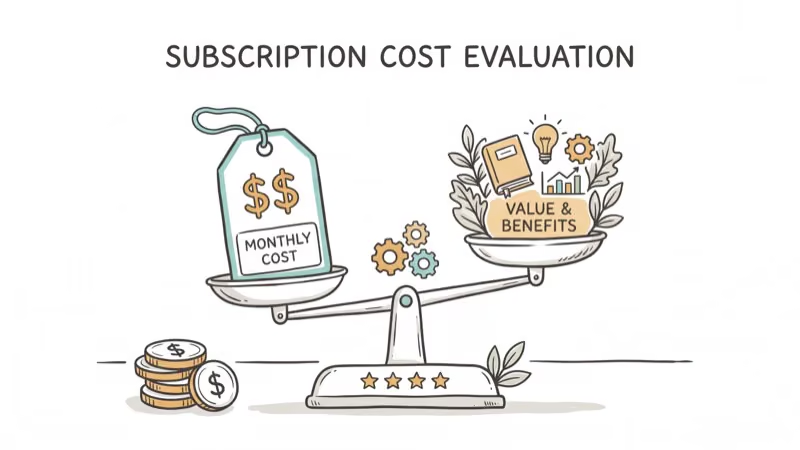
The value comparison: Babbel at $6.95/mo vs Super Duolingo at $6.67/mo are nearly identical in price. The real difference is that Duolingo’s free tier is seriously usable for long-term learning, making it the better choice for budget-conscious learners.
#Speech Recognition Compared
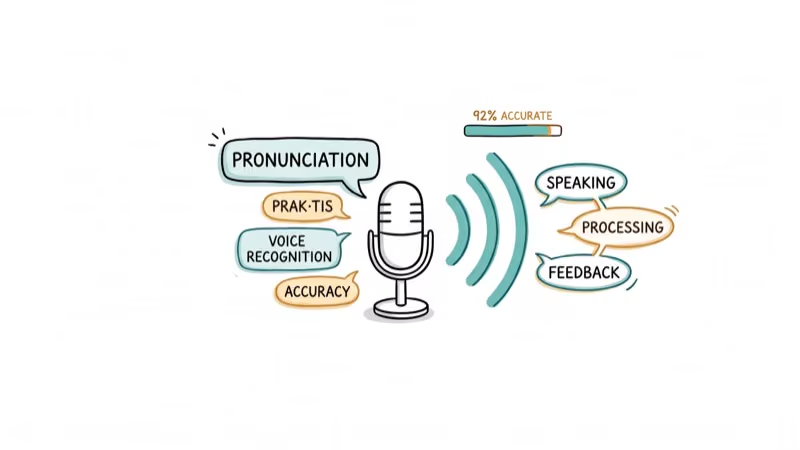
Babbel’s speech recognition is a stronger fit for learners who want structured pronunciation feedback.
According to Babbel’s technology blog, their speech recognition was developed specifically for language learners and accounts for non-native pronunciation patterns. It’s more forgiving than Google’s speech-to-text but stricter than Duolingo’s.
Duolingo’s speaking exercises are optional. You can skip them entirely, which means you could complete a full course without ever practicing pronunciation. If you want additional pronunciation practice outside these apps, tools like text-to-speech on Discord can help you hear proper pronunciation in real time.
#Who Should Choose Babbel?
Babbel fits you better if:
- You want structured grammar lessons with clear explanations
- You’re preparing for travel or work in a foreign language environment
- You prefer 10-15 minute focused sessions over quick bursts
- Speaking fluency is your primary goal
- You’re learning one of the 14 languages Babbel offers
Babbel is strongest for practical conversation goals like restaurant orders, directions, travel questions, and basic workplace introductions.
#Who Should Choose Duolingo?
Duolingo is the better pick if:
- You want to learn for free without any commitment
- Gamification keeps you motivated to practice daily
- You’re exploring multiple languages casually
- You want a less common language like Japanese, Korean, or Arabic
- Short lessons fit your schedule better than 15-minute sessions
The streak counter is seriously powerful. Duolingo creates more accountability than Babbel because it makes missed practice visible and ties progress to a daily habit loop.
#Using Both Apps Together
Many learners get the best results by combining both platforms:
- Use Babbel as your primary tool for grammar and conversation practice
- Use Duolingo for daily vocabulary reinforcement and streak motivation
- Start with Duolingo to build basic vocabulary, then switch to Babbel for deeper grammar
- Use Babbel for your main language and Duolingo to casually explore others
Pair either app with a language exchange platform like HelloTalk or Tandem, where you practice with native speakers. According to PCMag’s language app comparison, combining structured courses with real-world practice produces the fastest results across all proficiency levels.
For extra listening practice, Spotify podcasts can supplement either app. For exploring creativity alongside language, apps that teach music theory use similar pattern-recognition skills that transfer to language learning.
#Bottom Line
Pick Babbel if you want to speak a language confidently within weeks and you’re willing to pay for structured lessons. Pick Duolingo if you want a free, habit-forming app that builds vocabulary gradually. For serious learners with budget flexibility, use both: Babbel for depth, Duolingo for daily practice.
#Frequently Asked Questions
Can I become fluent using only Babbel or Duolingo?
Neither app alone will make you fluent. Both can take you to a solid intermediate level, roughly A2-B1 on the CEFR scale. To reach fluency, you’ll need real-world conversation practice, immersion, and additional reading and listening exposure.
Is Babbel or Duolingo better for test preparation?
Babbel’s structured grammar focus makes it more useful for standardized tests. But neither app is designed for test prep specifically. For DELE, DELF, or JLPT preparation, use a dedicated test prep course alongside your app of choice.
Can I use Babbel or Duolingo offline?
Babbel offers offline mode for all subscribers. Duolingo offers offline lessons only for Super Duolingo (premium) users. The free Duolingo tier requires an internet connection.
How long does it take to complete a course on each app?
Babbel courses typically take 6-12 months with daily 15-minute sessions. Duolingo doesn’t have a fixed endpoint since new content is regularly added, but completing the main tree for a popular language like Spanish takes 6-9 months with consistent daily use.
Does Duolingo or Babbel offer certificates?
Babbel doesn’t offer certificates. Duolingo offers the Duolingo English Test (DET), an accredited proficiency test accepted by over 4,500 institutions globally. The DET costs $65 and is separate from the regular Duolingo app.
Which app is better for kids?
Duolingo’s gamified approach is more engaging for children ages 8 and up. Duolingo also has a dedicated Duolingo for Schools platform that lets teachers assign lessons and track student progress. Babbel targets adult learners and lacks kid-specific features.
Google Messages Error 3100: Why RCS Is Broken on Galaxy
Google Messages RCS error 3100 hits Galaxy owners after phone or carrier switches. Google told 9to5Google a fix is coming. Here's what actually helps.

Is This Bank App Real? Spot a Fake App on Your Home Screen
A bank app can land on your home screen from a web page with no install warning. Learn the checks that tell a real banking app from a phishing web app.
Apps Crashing After iOS 27 Update? Fix Order (2026)
Apps crashing after the iOS 27 update? Update the app in the App Store first, then offload and reinstall to clear stale cache, then restart. The fix order.
Do AI Translation Earbuds Work Offline? What to Know
Do AI translation earbuds work offline? A few do with downloaded language packs, but most need the cloud. Here's what works offline and what you give up.